Lichess Tutor Gave Me One Red Box for Speed. Twice.
Lichess Tutor analyzed 409 of my games with Stockfish 19, separated them into blitz and classical, and compared each part of my play with players near the same rating.
Then it gave me one red box for speed.
Twice.
This is still a beta. It is also the clearest report card I have seen for my own chess because it does not pretend to be a coach, a personality, or an oracle. Lichess describes Tutor as statistical analysis and comparison to peers: concrete measurements, organized into categories, with no AI performance wrapped around them.
The result is not one number. It is a map of where my chess changes when the clock changes.
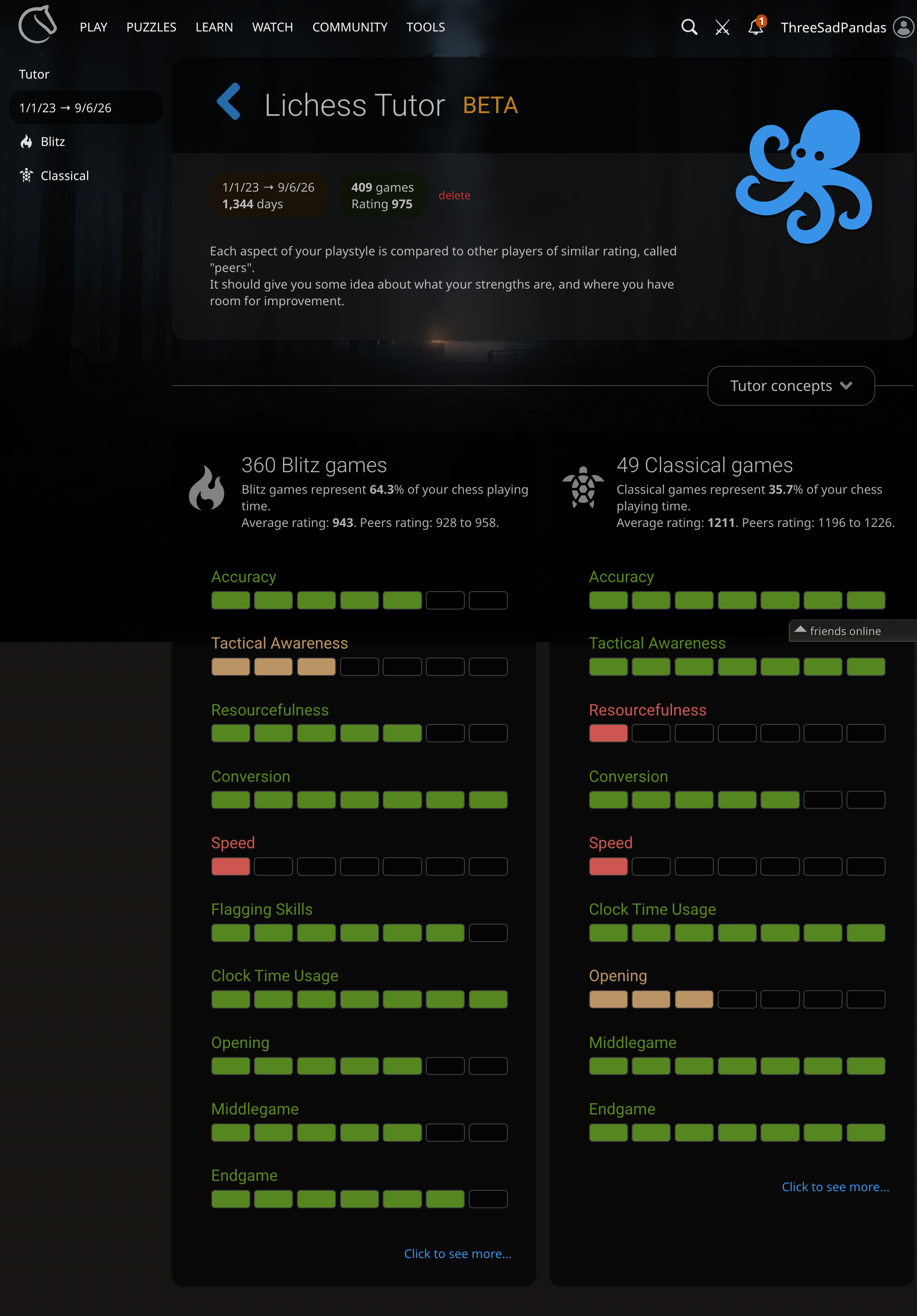
The overview for 409 games played from January 1, 2023 through September 6, 2026.
The sample
The report covers 1,344 days, from January 1, 2023 through September 6, 2026. Tutor included 360 blitz games and 49 classical games.
| Time control | Games | Share of playing time | Average rating | Peer range |
|---|---|---|---|---|
| Blitz | 360 | 64.3% | 943 | 928–958 |
| Classical | 49 | 35.7% | 1,211 | 1,196–1,226 |
| Combined report | 409 | 100% | 975 headline rating | — |
That distinction matters. Tutor is not saying that a five-box skill is five-sevenths objectively good at chess. The boxes show how one aspect of my games compares with similar-rated players in that time control.
In other words, the report is graded on a curve.
Finally, a curve I can blame.
Blitz: the position is fine until the queen gets involved
The blitz summary says my speed is much worse than my peers’, while my conversion and endgame play are much better. It also names the Scandinavian Defense as White as a specific weakness.
Here is the report in calm, smug Markdown:
| Blitz category | Score | Relative result |
|---|---|---|
| Accuracy | 5/7 | Strength |
| Tactical awareness | 3/7 | Below my stronger categories |
| Resourcefulness | 5/7 | Strength |
| Conversion | 7/7 | Major strength |
| Speed | 1/7 | Major weakness |
| Flagging skills | 6/7 | Strength |
| Clock time usage | 7/7 | Major strength |
| Opening | 5/7 | Strength |
| Middlegame | 5/7 | Strength |
| Endgame | 6/7 | Major strength |
The piece table becomes even more specific:
| Blitz piece | Score |
|---|---|
| Pawn | 5/7 |
| Knight | 7/7 |
| Bishop | 6/7 |
| Rook | 6/7 |
| Queen | 2/7 |
| King | 7/7 |
The queen is not merely the lowest piece score. It is the only piece score shown in red. My knights and king receive seven green boxes while the most powerful piece on the board receives two red ones.
That is actionable. “Get better at blitz” is fog. “Review queen moves, tactical misses, and every White Scandinavian in the sample” is a study session.
The visible opening scores reinforce the point:
| Blitz opening | Color | Score |
|---|---|---|
| Italian Game | White | 4/7 |
| Scandinavian Defense | White | 1/7 |
| Queen’s Pawn Game | Black | 3/7 |
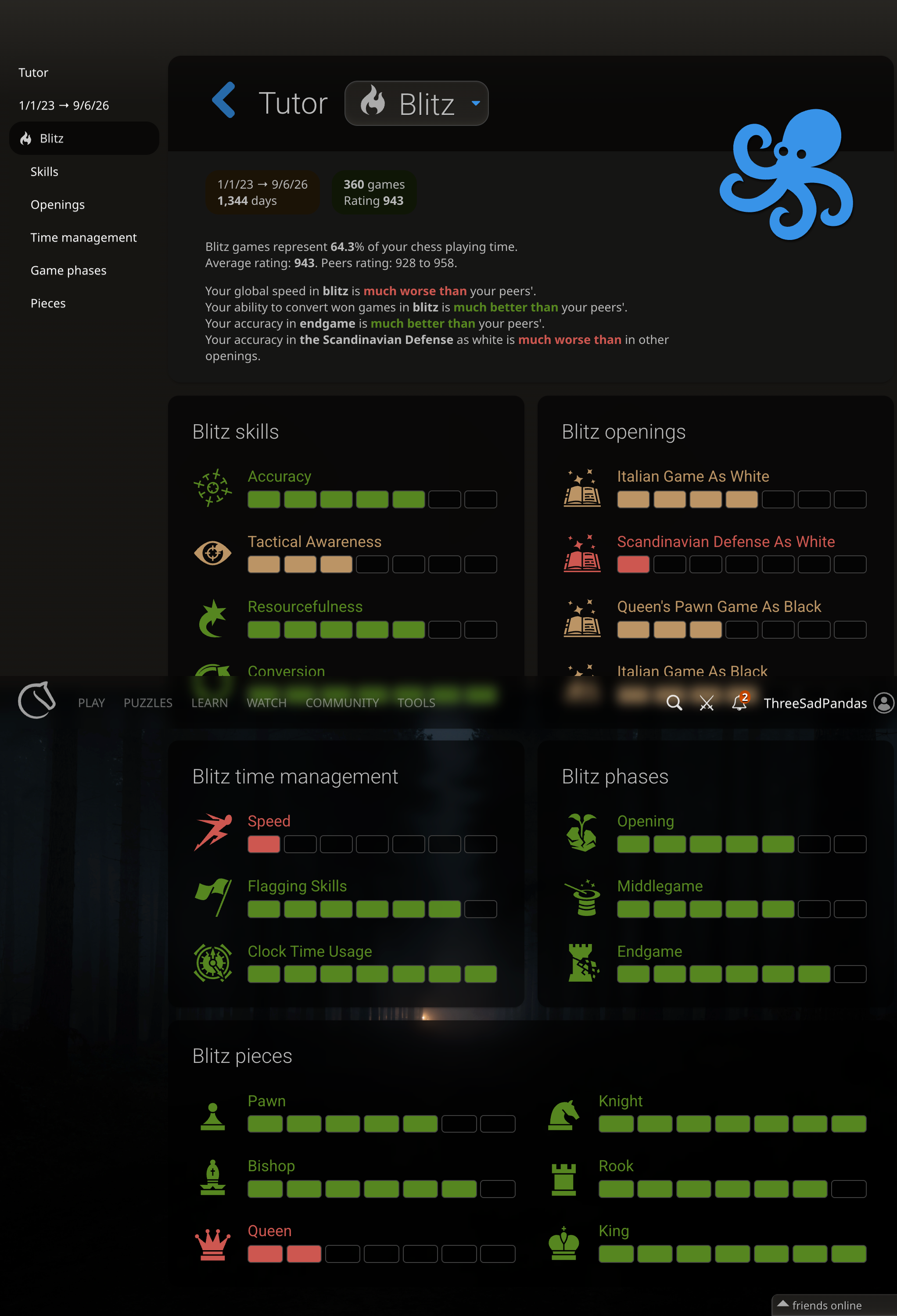
Blitz: wonderful conversion, strong endgames, alarming queen behavior.
Classical: accurate, composed, and apparently helpless
The classical report is almost a different player.
Accuracy rises from five boxes to seven. Tactical awareness rises from three to seven. The middlegame and endgame both reach seven. Every piece scores at least five, and four opening families receive either three or seven boxes.
Then resourcefulness falls to one red box.
| Classical category | Score | Relative result |
|---|---|---|
| Accuracy | 7/7 | Major strength |
| Tactical awareness | 7/7 | Major strength |
| Resourcefulness | 1/7 | Major weakness |
| Conversion | 5/7 | Strength |
| Speed | 1/7 | Major weakness |
| Clock time usage | 7/7 | Major strength |
| Opening | 3/7 | Weakest phase |
| Middlegame | 7/7 | Major strength |
| Endgame | 7/7 | Major strength |
| Classical piece | Score |
|---|---|
| Pawn | 7/7 |
| Knight | 6/7 |
| Bishop | 5/7 |
| Rook | 7/7 |
| Queen | 7/7 |
| King | 5/7 |
| Classical opening | Color | Score |
|---|---|---|
| Sicilian Defense | White | 7/7 |
| Four Knights Game | White | 7/7 |
| Italian Game | Black | 3/7 |
| Scotch Game | Black | 7/7 |
My first reading is that classical gives me enough time to find good moves when the position is under control, but not necessarily enough resilience after it stops being under control. Accuracy can describe the decisions I made. Resourcefulness asks what happened when I needed to create chances from a worse position.
That interpretation needs game review, not faith in a colored bar. The bar tells me where to look. The games have to tell me why.
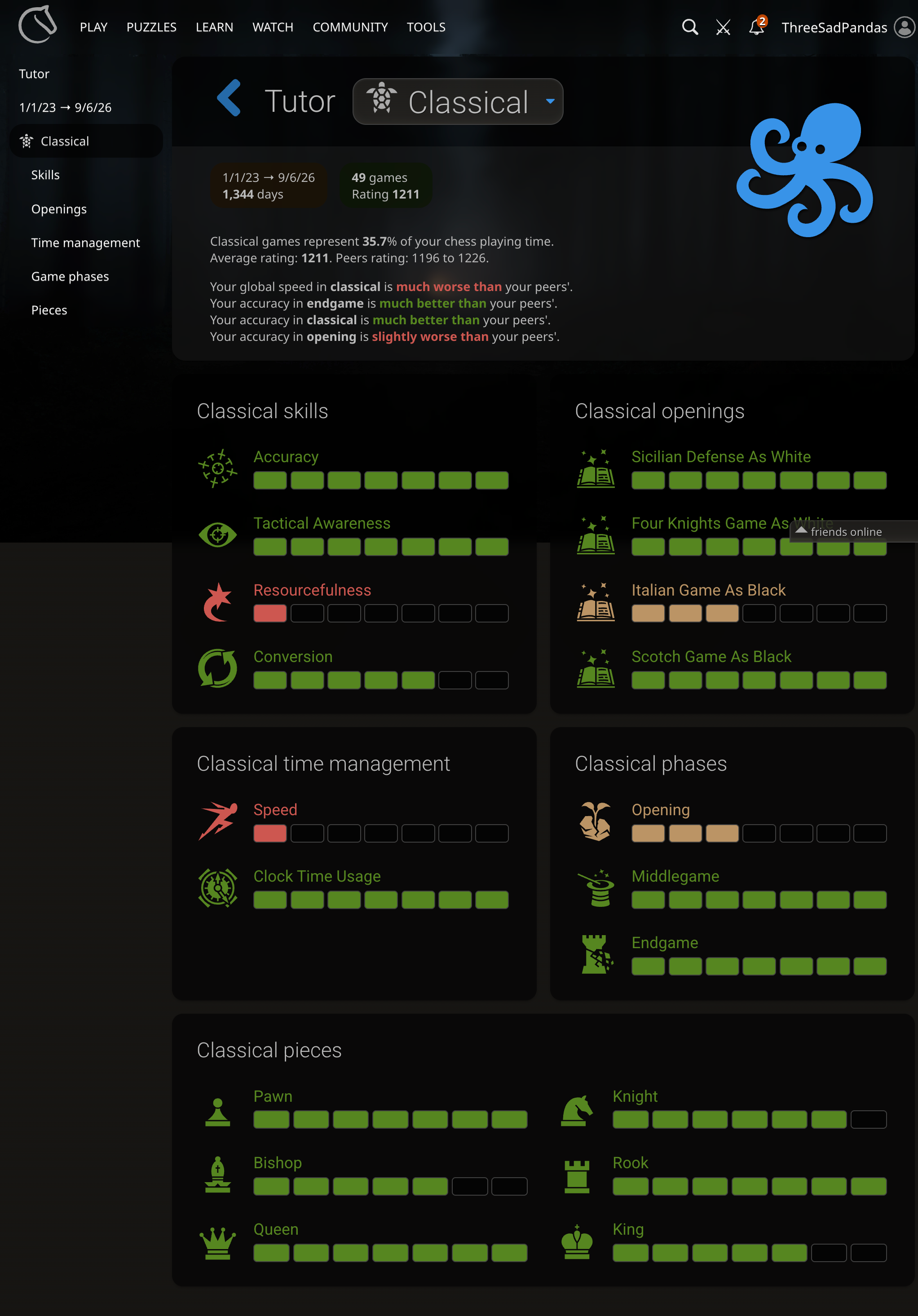
Classical: seven boxes for accuracy, one for resourcefulness, and absolutely no interest in being subtle.
The full comparison
Placed side by side, the report stops looking like a list and starts looking like a diagnosis.
| Metric | Blitz | Classical | What changes |
|---|---|---|---|
| Accuracy | 5/7 | 7/7 | The classical sample is cleaner |
| Tactical awareness | 3/7 | 7/7 | The classical sample is far stronger |
| Resourcefulness | 5/7 | 1/7 | Classical defense needs investigation |
| Conversion | 7/7 | 5/7 | Blitz advantage is unusually strong |
| Speed | 1/7 | 1/7 | The shared weakness |
| Clock time usage | 7/7 | 7/7 | The shared strength |
| Opening | 5/7 | 3/7 | Classical starts are less convincing |
| Middlegame | 5/7 | 7/7 | Classical separates itself |
| Endgame | 6/7 | 7/7 | Strong in both formats |
The strangest pair is Speed: 1/7 and Clock Time Usage: 7/7 in both formats.
I do not want to invent a definition that Tutor does not show on the report. At minimum, those two metrics are measuring different things. I can use the available clock without matching my peers’ pace. I can avoid wasting the whole clock and still spend the wrong amount of time on individual decisions.
That fits a lesson I was already trying to learn: spend the clock where it matters. Tutor did not replace that lesson. It found the same problem in 409 games and gave it two identical red bars.
What I am keeping, and what I am fixing
The green bars are not decoration. Conversion in blitz, endgames in both formats, classical accuracy, and clock usage across the board are things to preserve. A useful improvement plan should not destroy the parts that already work.
The red and tan bars produce a short list:
- Review every blitz game in the sample where an early queen move, queen trade, or queen loss changed the evaluation.
- Build a simple White response to the Scandinavian instead of improvising on move two.
- Study the classical losses from the first moment the position became worse, looking for active defensive resources rather than only the final blunder.
- Compare move times at critical positions with move times spent on routine positions.
- Keep playing endgames. Apparently something is cooking there.
This is what I want from chess software. Not a synthetic coach telling me to believe in myself. Not a chatbot manufacturing a personality from my move history. A large sample, a relevant peer group, a set of measurements, and a direct path back to the games.
Lichess Tutor did not tell me who I am as a player.
It did something more useful.
It told me exactly where to start looking.