Dabeed has been a good friend of mine for a very long time. He is also better at chess than I am.
These are both things I knew before this game. The Vienna Gambit was a thing I learned afterward.
I had fourteen days per move. My queen was gone by move eleven.
Friendship is a wonderful opportunity for continued personal growth.
| Game | dabeed23–ThreeSadPandas |
| Dates | October 18–21, 2026, Pacific time |
| Time control | Rated correspondence, 14 days per move |
| Opening | Vienna Game: Vienna Gambit (C29) |
| Ratings at the start | dabeed23 1840?; ThreeSadPandas 1596 |
| Result | 1–0; I resigned after 27…Kb7 |
| Engine | Stockfish 19; five million nodes per search, plus deeper opening checks |
The question mark is Lichess’s provisional-rating marker. Dabeed being better at chess than me is my own assessment, independent of the punctuation.
This Engine Room visit has one main job: understand the opening well enough that the next time somebody plays it, I can recognize the problem while I still own a queen. The rest of the game will receive a shorter inspection. It has suffered enough.
Replay the game
What is the Vienna Gambit?
The Vienna Game begins:
1.e4 e5 2.Nc3
White develops the queen’s knight before the king’s knight. One useful consequence is that the f-pawn still has a clear road forward. Against 2…Nf6, White can play:
3.f4
That is the Vienna Gambit. White offers the f-pawn to Black’s e5-pawn, challenges Black’s center, and prepares active play. It has a family resemblance to the King’s Gambit, but the knights already on c3 and f6 change the tactics. In particular, e5 can attack Black’s developed knight while White gains space.
A gambit offers material for something else: time, development, open lines, an attack. Recognizing one means asking what the other player gets if I cooperate. It does not mean automatically taking the pawn and assuming the paperwork can be sorted out later.
The English Chess Federation’s Vienna Gambit lesson gives a useful introduction to these ideas. My contribution to the literature is the game below.
The familiar trap I did not play
One common problem for Black is:
3…exf4 4.e5
Black has accepted the pawn, but now the f6-knight is attacked. The unglamorous retreat …Ng8 is a standard answer; trying to preserve the appearance of development can make things worse. White gains room to develop and build a center.
That was not my game. I did not take on f4. I found a different route to the same uncomfortable discovery: White’s central pawns can gain time by chasing my knights.
How I actually fell for it
3…Nc6 4.fxe5 Nxe5 5.d4
I played 3…Nc6, bringing out my other knight. An ordinary developing move. Two knights out. A respectable-looking beginning.
The problem is the sequence it allows.
Stockfish prefers 3…d5, keeping the position roughly balanced. After my 3…Nc6, it gives White about +1.7. That is an opening advantage, not a forced win, but the natural-looking move has already made my job harder.
Dabeed captures my e5-pawn with 4.fxe5. I answer 4…Nxe5, using the knight from c6 to take his pawn. Material is level again.
Then comes 5.d4.
The d-pawn attacks that knight on e5. White is building a center while making me spend another move on a piece I just moved. I retreat 5…Nc6, and Dabeed plays 6.e5, attacking my other knight on f6.
The moves fit together:
3…Nc6 4.fxe5 Nxe5 5.d4 Nc6 6.e5
White gets pawns on d4 and e5. Black gets a series of questions about where the horses are going.
This is why “develop a piece” is a principle rather than a guarantee. I developed, captured, and retreated the same knight while Dabeed used his pawns to take space with tempo. The position needs a concrete answer to the pawn advances.
There was already a better retreat on move five: Stockfish prefers 5…Ng6 to my 5…Nc6. That still leaves White with the easier game. The simplest repair is earlier, before the pawn chase starts.
6…Nd5? 7.Nxd5
My f6-knight needs a safe square. I choose d5.
Dabeed’s knight on c3 controls d5.
7.Nxd5.
There is no pawn or piece ready to recapture his knight. I have lost a piece. The opening did not force me to put it there; I supplied that part myself.
Retreating to g8 would at least keep the knight. It is unpleasant to bring a developed piece home. It is more unpleasant to discover that its new square belongs to somebody else’s knight.
This is the moment to apply the fifth step of my blunder check: imagine the move completed, then inspect the destination. On d5, the knight is immediately capturable. I do not need to know the name of the opening to notice that.
7…g6??: the quiet move that made everything louder
I play 7…g6. Whatever future I am arranging for my bishop, the present already contains an extra white knight.
This is the biggest additional mistake in the opening. Black still had counterplay with 7…Qh4+, forcing White to answer a check rather than continue the attack uninterrupted. One engine continuation is 8.Ke2 Nxd4+, taking a central pawn with another check. It is uncomfortable for White too.
I checked this position more deeply, at twenty million nodes per search. Stockfish’s best defense is already bad, around +3.7 for White. My quiet pawn move makes it about +10.2.
Those numbers are evaluations, not literal material counts. The useful distinction is that a difficult defense has become a rout. When I am a piece down with an exposed position, I need to look for forcing activity before decorating the kingside.
Dabeed uses it immediately: 8.Nf6+. The knight jumps from d5 to f6 with check. I move my king to e7, losing the right to castle.
The knight is protected by the pawn on e5. The only other legal reply is 8…Qxf6, when 9.exf6 takes the queen. Stockfish slightly prefers that miserable transaction. By this point, choosing a different king move cannot rescue the opening.
Then 9.Bg5 sets up the really instructive part.
Look at this diagonal:
White bishop g5 → White knight f6 → Black king e7 → Black queen d8
The knight currently blocks its own bishop. If that knight moves with check, the bishop’s line opens at the same time. My king and queen are standing behind each other on that line.
That seems like the sort of arrangement I should object to.
9…h6 10.Nd5+ Ke8 11.Bxd8
I object to the bishop instead.
9…h6 attacks it. Unfortunately, Dabeed does not have to move the bishop. He has a stronger move:
10.Nd5+!
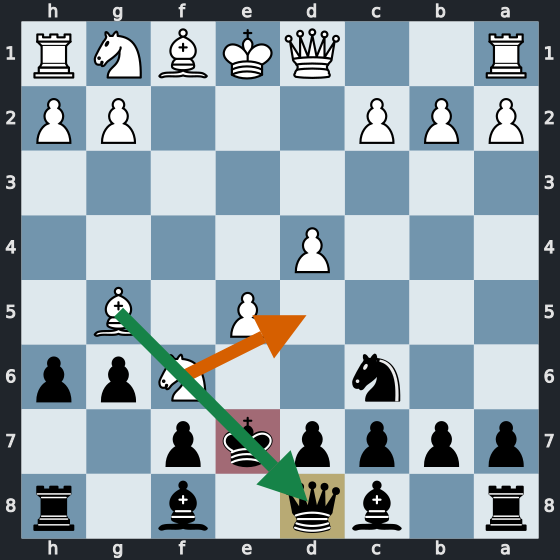
After 9…h6: the knight can move with check and uncover the bishop’s attack at once.
It is double check. The knight on d5 attacks my king on e7, and the bishop on g5 now attacks it through the vacated f6-square. I must move the king; capturing or blocking just one checking piece will not answer the other.
In the game I choose 10…Ke8, and Dabeed takes my queen with 11.Bxd8. I recapture the bishop with 11…Kxd8.
The receipt: one knight lost, followed by my queen exchanged for a bishop.
There is an important engine-room distinction here. 9…h6 is not a fresh, game-changing blunder: White’s advantage is already enormous, and the evaluation barely changes. 10…Ke8 is the engine’s preferred defense to the double check; the other legal king move, 10…Ke6, allows a forced mate in four. The diagram explains how the damage was collected. The decisions that caused it came earlier.
Moving the h-pawn looked like a threat. Dabeed’s reply was a check that uncovered another check and exposed my queen. My threat was operating several pay grades below his.
What I want to do differently next time
Meet 3.f4 in the center: 3…d5
My practical answer to remember is:
1.e4 e5 2.Nc3 Nf6 3.f4 d5
Instead of letting White build the entire center while my knights relocate, Black immediately challenges e4. After 4.fxe5, the thematic reply is 4…Nxe4.
The difference is the black pawn on d5. If White exchanges knights with 5.Nxe4, Black has 5…dxe4. That central pawn supports the operation. In my game, the knight I put on d5 had no such recapture behind it.
The deeper opening check confirms 3…d5 as the engine’s first choice, with a roughly balanced evaluation of −0.16 after the move. White’s gambit asks a question; Black has a good answer.
White has other choices after 4…Nxe4, including 5.Nf3 and 5.d3. This is a starting point for preparation, not a claim that Black can play the next ten moves without looking. I want to learn the resulting positions rather than memorize one line and become offended when Dabeed deviates.
Recognize the pawn chase, even if I forget the book
The useful warning pattern is d4 attacks a knight on e5; e5 attacks a knight on f6. Before choosing a square, check which white pawns and pieces control it. A retreat can be the right move. A knight does not receive extra points for dying farther from home.
And before playing a move like …h6, inspect forcing replies. A bishop under attack can stay exactly where it is if its partner can deliver double check. The question is not merely “What am I threatening?” It is “What can he do first?”
The remaining sixteen moves, with mercy
The game continued through move 27. I did not win the queen back.
There was some sensible resistance: 12…Bb4+ 13.Nxb4 Nxb4 exchanged a bishop for the advanced white knight. It did not repair the missing queen. Dabeed developed, castled on move 17, and kept a safer king while mine remained in the middle.
My 18…b5 chased his bishop while his passed pawn sat on d6. That pawn later advanced with 22.d7+, beginning 22…Bxd7 23.Nxd7 Kxd7 24.Bxd5 cxd5. The minor pieces came off; the queen advantage stayed.
Stockfish also dislikes 17…c6 and 20…Rf8, with …a5 and …Kc8 respectively offering more resistance. By then these are ways of making a lost position worse, rather than separate explanations for the result. I can work on those after I stop donating the queen in the opening.
After 27.Qxg6+ Kb7, White had a queen, two rooks and six pawns against my two rooks and four pawns. I resigned. This was a resignation, not a timeout or a checkmate, and fourteen days per move leaves very little room for a convincing clock-related explanation.
There are details worth improving later, but the next useful homework assignment is already waiting on move three.
The complete score
The PGN uses UTC, so its October 19 start date is October 18 in Pacific time. Correspondence supplied no move-clock annotations; the pink comments mark the opening’s turning points instead.
[Event "rated correspondence game"]
[Site "https://lichess.org/FlePi8VU"]
[Date "2026.10.19"]
[Round "-"]
[White "dabeed23"]
[Black "ThreeSadPandas"]
[Result "1-0"]
[GameId "FlePi8VU"]
[UTCDate "2026.10.19"]
[UTCTime "01:47:20"]
[WhiteElo "1840"]
[BlackElo "1596"]
[WhiteRatingDiff "+70"]
[BlackRatingDiff "-9"]
[Variant "Standard"]
[TimeControl "14 days per move"]
[ECO "C29"]
[Opening "Vienna Game: Vienna Gambit"]
[Termination "Normal"]

1. e4 e5 2. Nc3 Nf6 3. f4
{ The Vienna Gambit: White offers the f-pawn and challenges e5. }
3... Nc6 { 3...d5 is the central counterstrike to remember. }
4. fxe5 Nxe5 5. d4 Nc6 6. e5 Nd5
{ The knight lands on a square controlled by White's c3-knight. }
7. Nxd5 g6 { 7...Qh4+ offered more resistance. }
8. Nf6+ Ke7 9. Bg5 h6 10. Nd5+
{ Double check: the knight attacks the king and uncovers the bishop on g5. }
10... Ke8 11. Bxd8 { The bishop takes the queen. } 11... Kxd8
12. Nf3 Bb4+ 13. Nxb4 Nxb4 14. c3 Nd5 15. Qd2 d6 16. Bc4 Be6
17. O-O c6 18. exd6 b5 19. Bb3 a6 20. Ne5 Rf8 21. Qxh6 Ke8
22. d7+ Bxd7 23. Nxd7 Kxd7 24. Bxd5 cxd5 25. Qh3+ f5
26. Qh7+ Kc6 27. Qxg6+ Kb7 1-0
Engine-room receipts
I reviewed the completed game with Stockfish 19: five million nodes per search, three candidate lines, four threads, and 512 MB hash. Each resulting position also received a separate search. Deeper checks of 3…d5 and the defense before 7…g6 used twenty million nodes per search, with the same thread, hash and candidate-line settings.
Positive evaluations favor White. The five-million-node analysis gives this picture:
| Position after my move | Evaluation | What changed |
|---|---|---|
| 3…Nc6 | +1.72 | White can build the center while chasing knights |
| 5…Nc6 | +2.23 | e5 gains another tempo |
| 6…Nd5 | +3.80 | The knight can be captured |
| 7…g6 | +9.57 | I miss forcing counterplay and allow Nf6+ |
| 9…h6 | +10.46 | The queen-losing situation is already established |
Small evaluation differences between searches do not change the homework: challenge the center, find a safe square for the knight, and look for a discovered attack before chasing a bishop.
Dabeed, well played. I now know the name of the opening.
This represents progress. The queen has asked for more concrete evidence.